Neither marketplace wins everything.
Five things the data shows. Click any finding to jump to the detail.
01 · Price
Discogs owns the $25–$100 market
Between $25 and $100, Discogs made about seven in ten sales (72.7% for $25–$50 and 70.2% for $50–$100). Its lead was much narrower for $10–$25 records (52.7%).
At both ends of the market there was no clear winner. Above $100, sales split almost evenly (51.4% eBay). Below $10, eBay made 54.3% of sales, but that lead came from one large seller; without them, Discogs made 59.8%. The extremes are where listing on both matters most.
Discogs owns the $25–$100 market
Share of cross-listed sales by marketplace, by price in USD (n = 9,317)
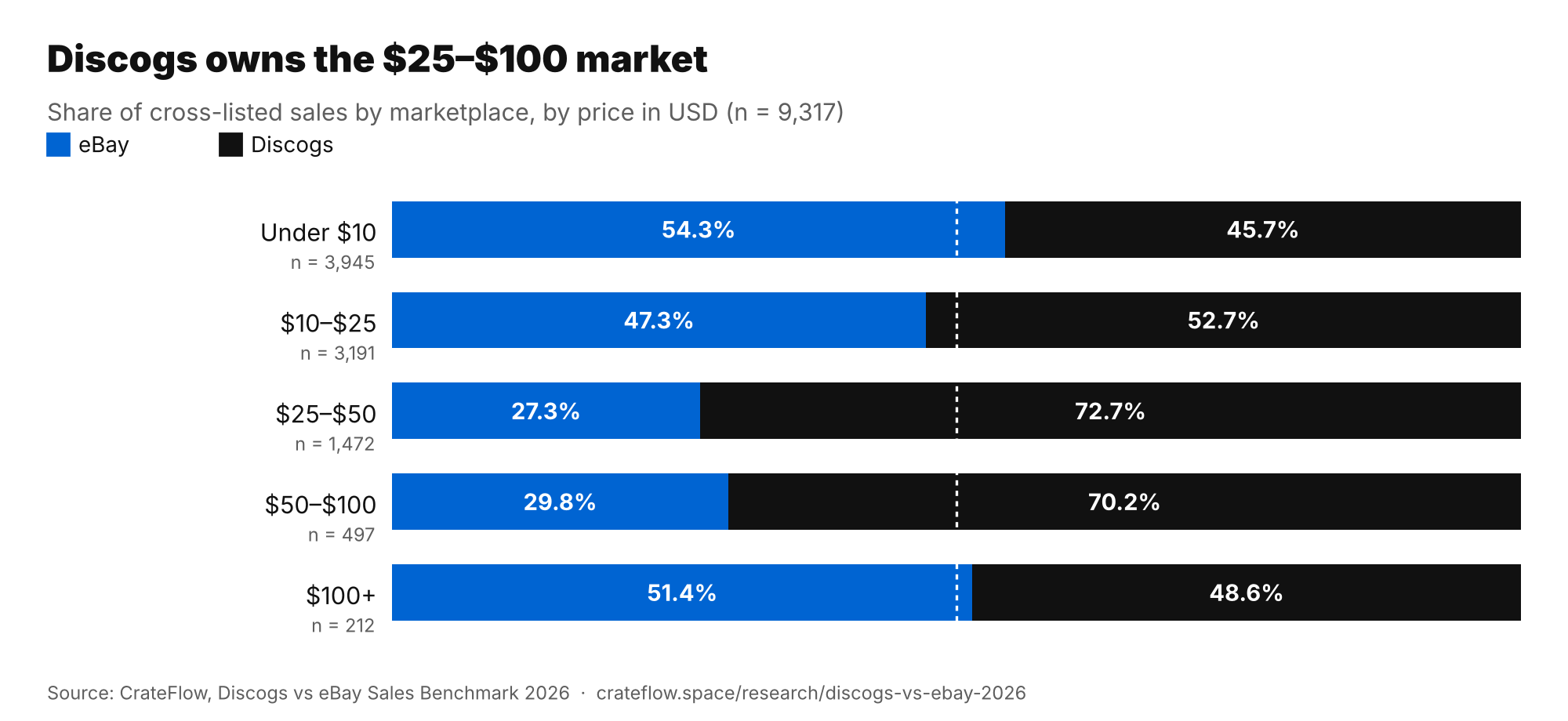
Price is the Discogs listing price, converted to US dollars at the monthly average exchange rate for the month of sale.
02 · Format
CDs go to eBay. 12-inch singles go to Discogs.
Discogs made 72.2% of 12" single and EP sales, its strongest lead in any format, and also led for LPs (55.0%) and 7" singles (55.8%). CDs went the other way: eBay made 70.7% of CD sales, or 60.7% excluding the largest seller.
CDs go to eBay. 12-inch singles go to Discogs.
Share of cross-listed sales by marketplace, by format (n = 9,202)
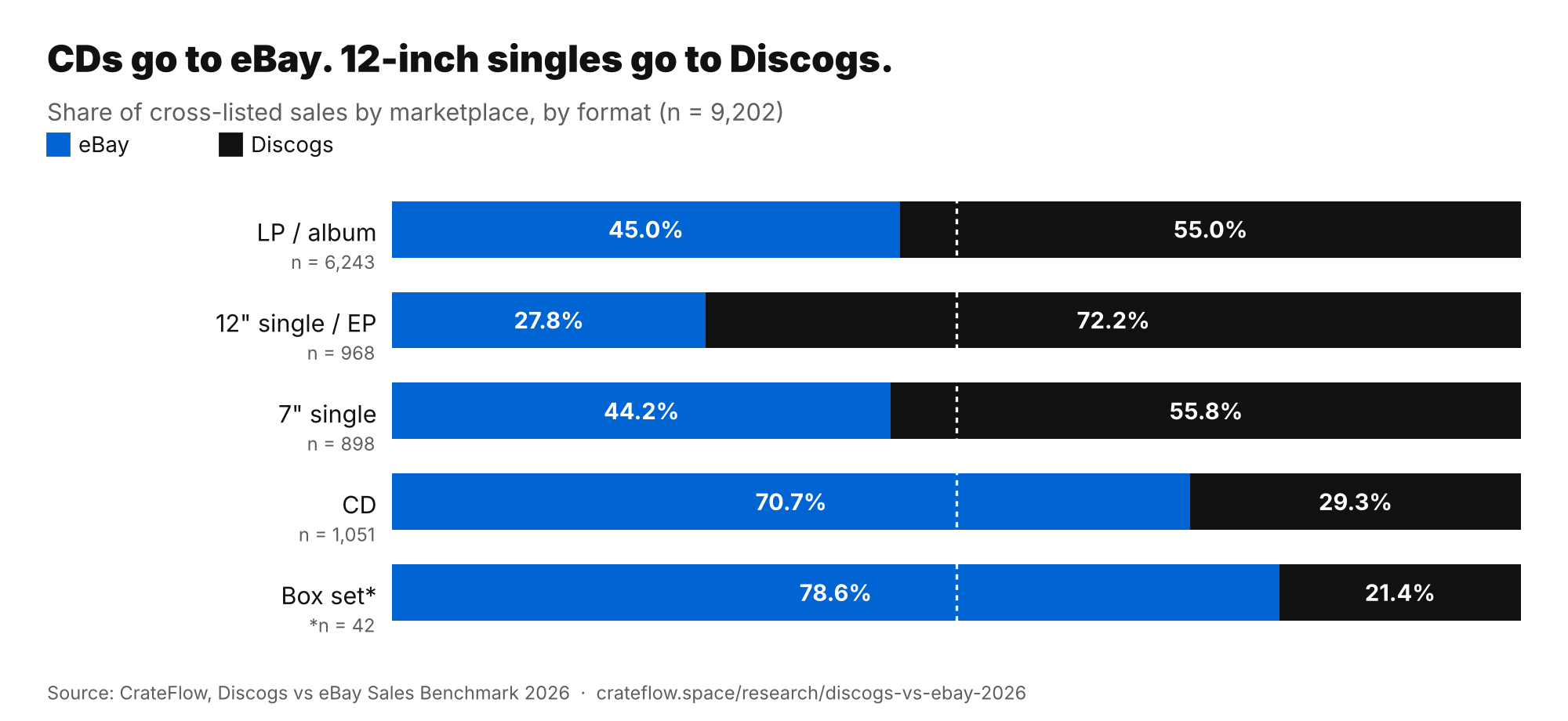
Excludes 115 sales in other formats. Box sets are shown for completeness, but 42 sales is too few to draw conclusions.
03 · Release era
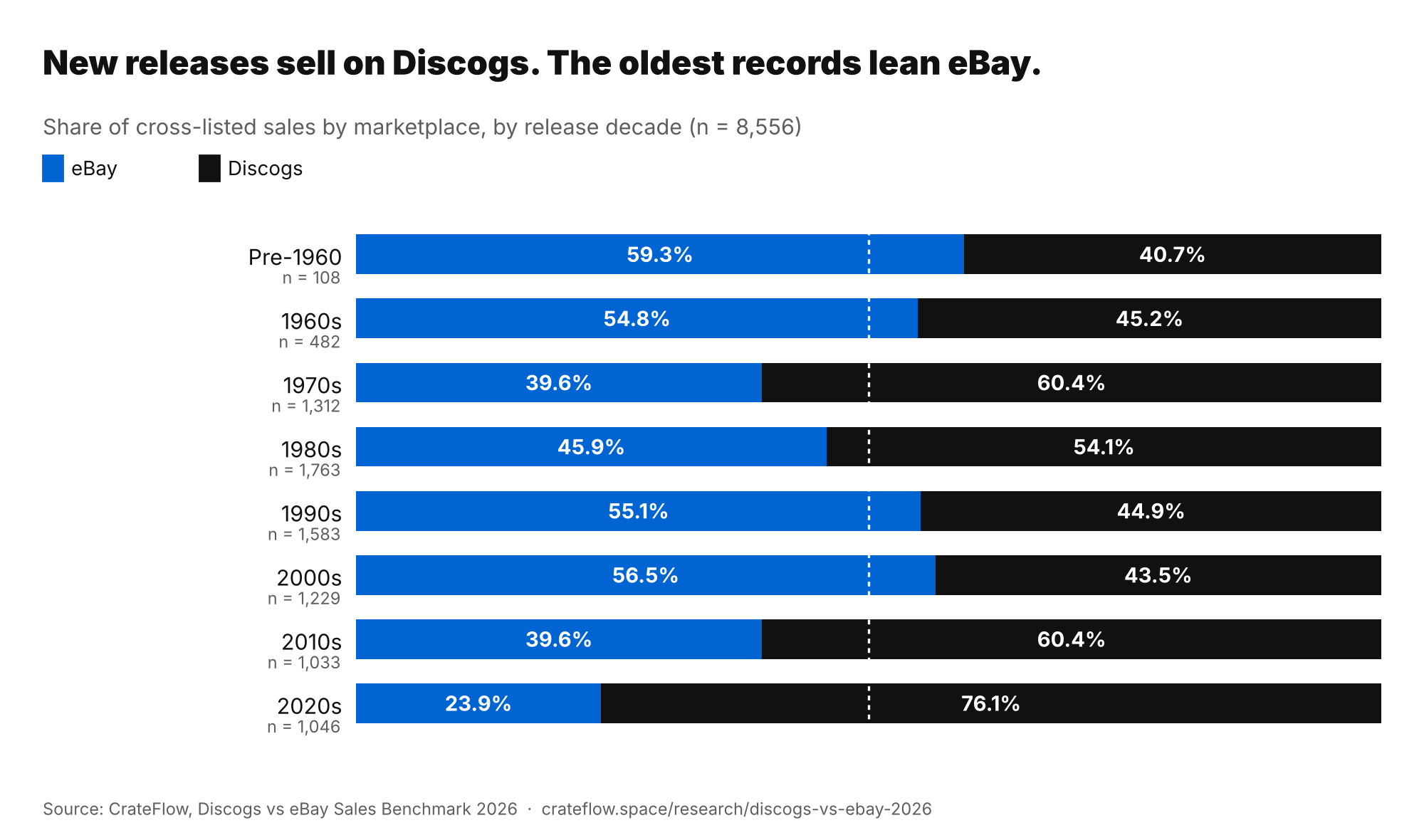
New releases sell on Discogs. The oldest records lean eBay.
Records released in the 2020s sold on Discogs 76.1% of the time, and 2010s releases 60.4%. At the other end, records from before 1970 leaned toward eBay: 54.8% of 1960s sales and 59.3% of pre-1960 sales. Those results don't depend on any single seller.
The 1990s and 2000s also appear to lean eBay, but that comes from the largest seller's stock. Without them, Discogs led both decades (56.9% and 54.2%), making Discogs the leader for every decade from the 1970s onward.
New releases sell on Discogs. The oldest records lean eBay.
Share of cross-listed sales by marketplace, by release decade (n = 8,556)
04 · Condition
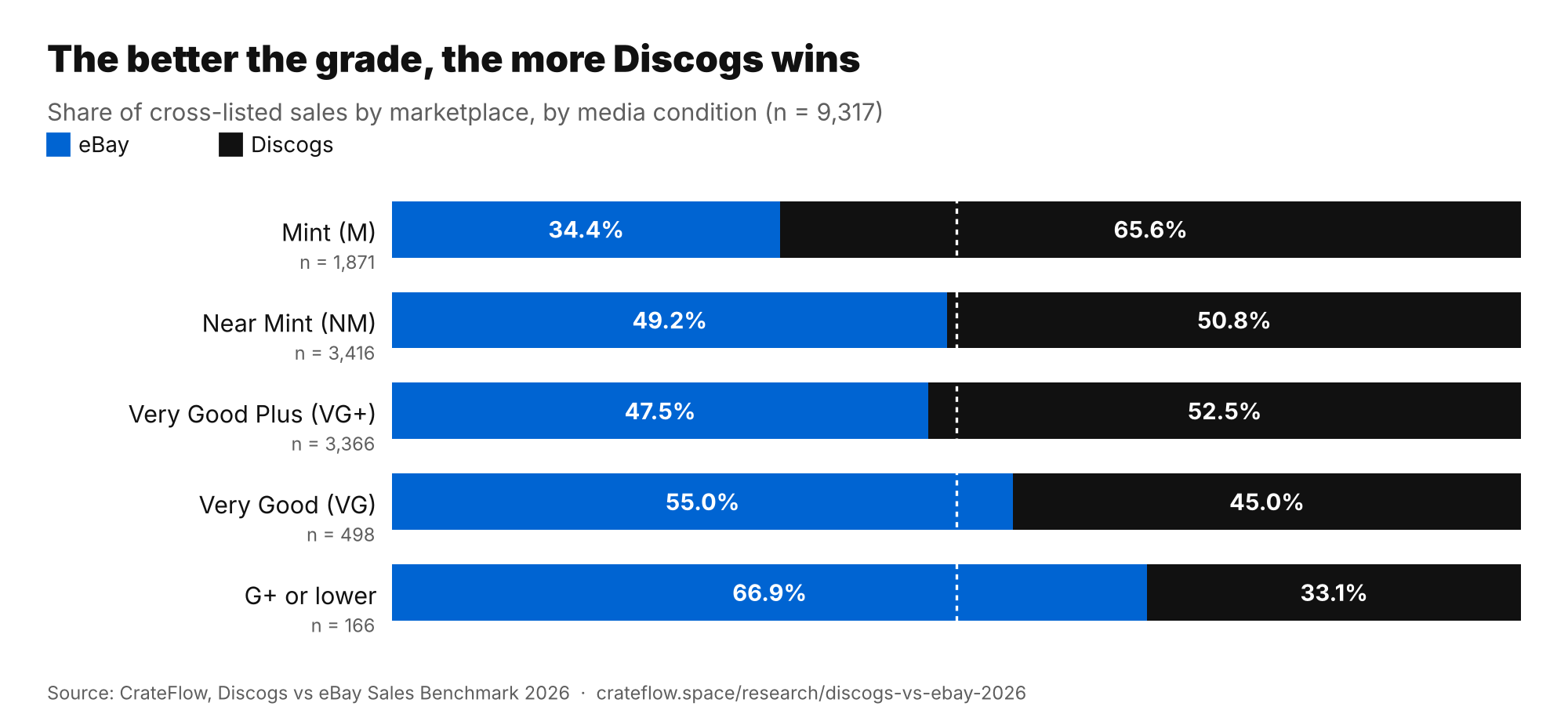
The better the grade, the more Discogs wins
Mint records sold on Discogs 65.6% of the time. Near Mint and Very Good Plus, which make up most of the sample, leaned only slightly toward Discogs. From Very Good downward the balance tipped to eBay, which made two-thirds of sales graded Good Plus or lower.
The better the grade, the more Discogs wins
Share of cross-listed sales by marketplace, by media condition (n = 9,317)
One pattern, not three
The Discogs leads for Mint copies, 2020s releases and 12" singles probably reflect much of the same stock: new and recent pressings, often sealed. Mint copies also cost about twice as much as Near Mint (median $21.51 vs $10.80).
05 · Speed
eBay's quick sales happen sooner
Measured from the day a record was live on both marketplaces, typical selling times were almost identical: a median of 24.5 days on eBay and 26.0 on Discogs. The difference was at the fast end. A quarter of eBay sales happened within 7.7 days, compared with 12.3 days on Discogs. For records over $50 there was no difference at all.
eBay's quick sales happen sooner
Days from cross-listing to sale (n = 8,350)
Quickest 25% of sales sold within
Median, all sales
Median, records over $50
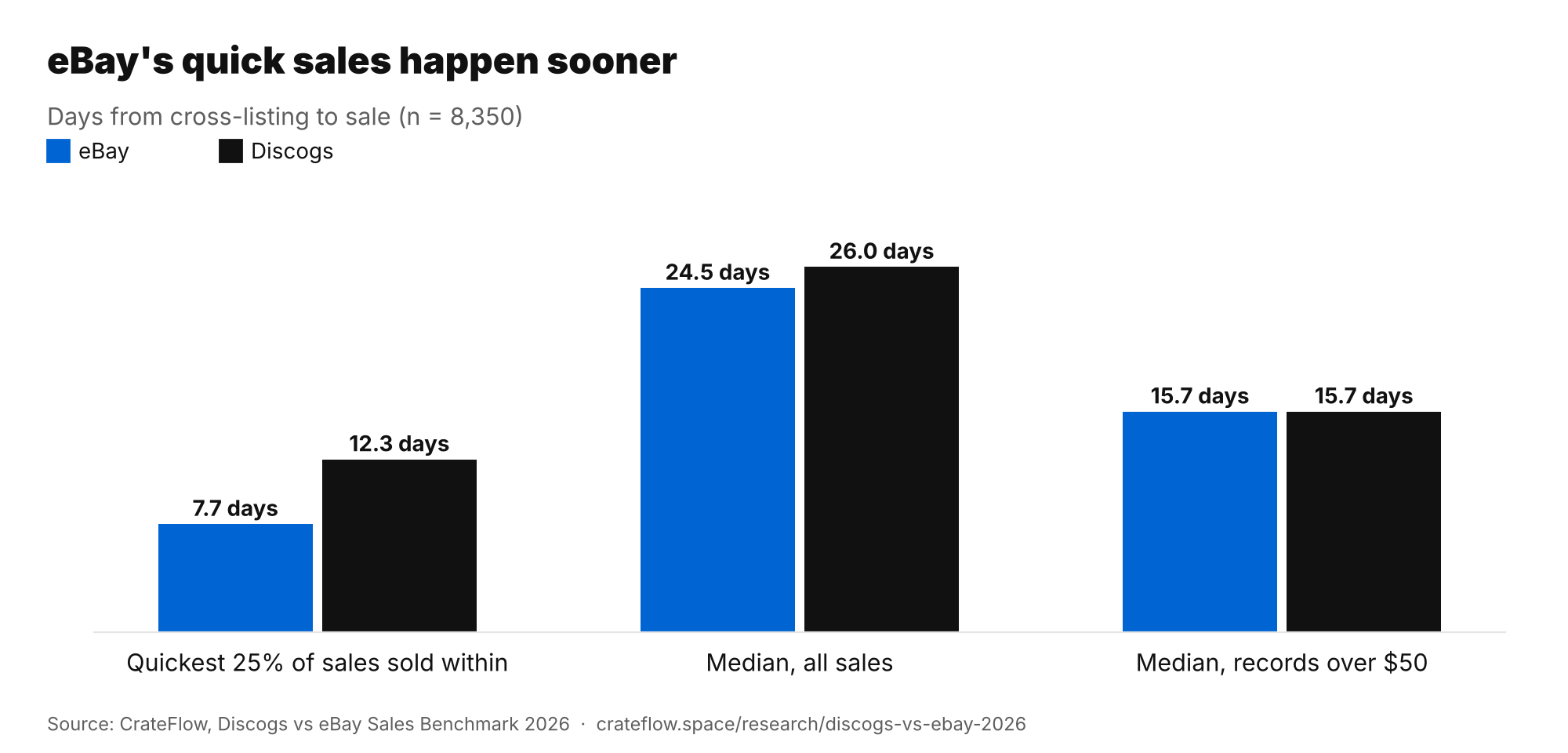
The clock starts when the record was listed on eBay, the point it was live on both marketplaces.
06 · Sell-through
One in five cross-listed records sold within 90 days
We tracked the 16,606 records cross-listed between April and July 2026. 11.6% sold within 30 days, 16.1% within 60 days and 20.6% within 90 days. By early November, 25.3% had sold on one of the two marketplaces.
One in five cross-listed records sold within 90 days
Share of records cross-listed Apr–Jul 2026 that had sold, by days since listing (n = 16,606)
11.6%
Within 30 days
16.1%
Within 60 days
20.6%
Within 90 days
25.3%
To date (early Nov)
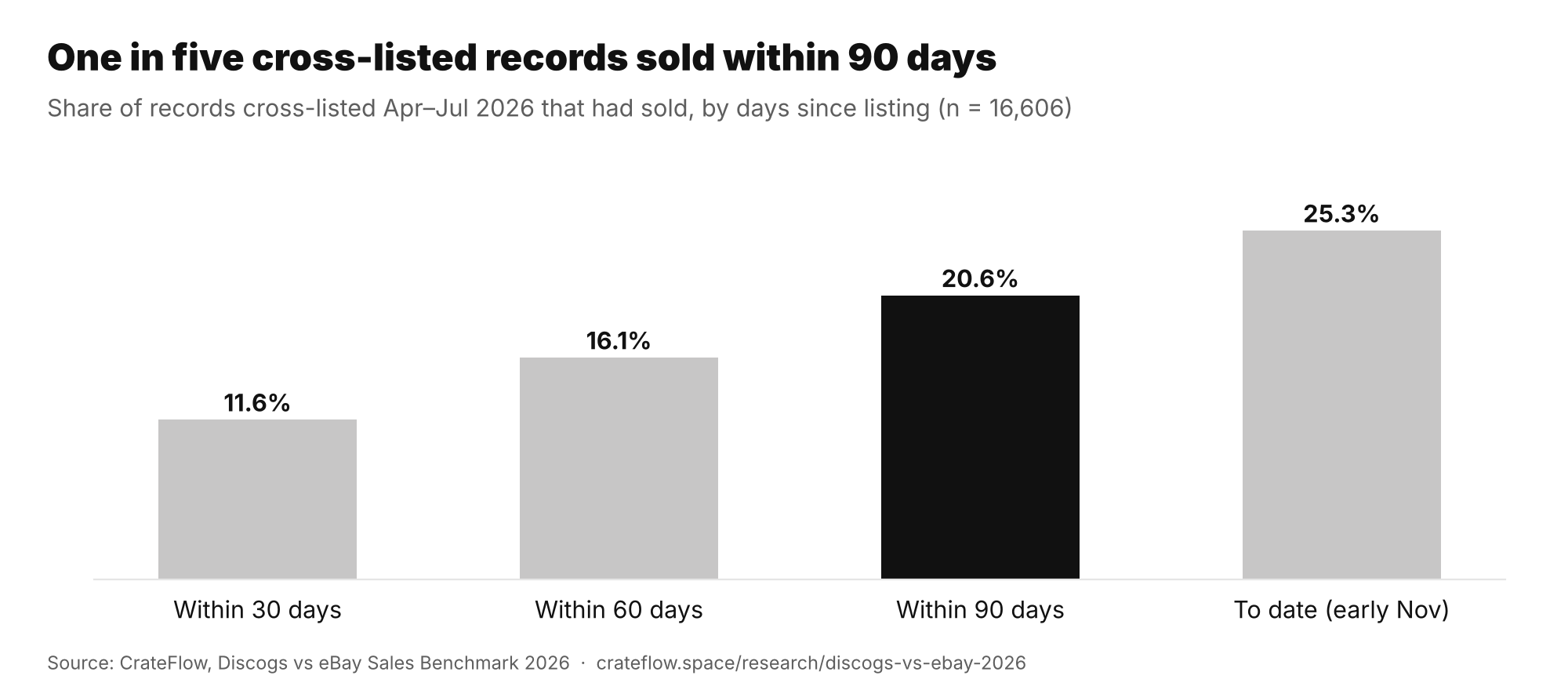
Listings from August onward are excluded because they have not yet had 90 days to sell.
For sellers
Use each marketplace for what it sells
These results describe where records sold, not why. They still point to some practical rules of thumb:
- $25–$100 records belong on Discogs. It made about seven in ten sales in that range.
- List the cheapest and most expensive records on both. Under $10 and over $100, neither marketplace had a clear lead.
- Don't skip eBay for CDs. eBay made between six and seven in ten CD sales.
- New and sealed pressings belong on Discogs. 2020s releases, Mint copies and 12" singles all leaned strongly toward Discogs.
- Give eBay a chance with older and well-played records. Pre-1970 releases and copies graded Very Good or lower leaned toward eBay.
- Expect about one in five cross-listed records to sell within 90 days. And end the duplicate listing quickly when one sells.
Selling on both? CrateFlow lists your Discogs inventory on eBay and ends the duplicate listing when a record sells on either marketplace.
How the sync worksMethodology
How we collected the data
This study uses aggregate data from CrateFlow's production database, frozen at 31 October 2026. The sample is every record listed on both Discogs and eBay through CrateFlow that later sold on one of the two marketplaces between 16 February and 31 October 2026: 9,317 sales from more than 100 sellers, mainly in the UK, US, Germany, Austria and Australia. Test accounts and cancelled orders are excluded.
78% of sales were priced in pounds, euros, Australian or Canadian dollars. Prices are the Discogs listing price, converted to US dollars at the monthly average exchange rate for the month of sale. eBay sale times come from eBay's checkout timestamp; Discogs sale times are recorded when CrateFlow detects the sale, a median of 14 minutes after the order.
Limitations
The sample reflects CrateFlow users and the records they chose to cross-list. It is not a random sample of Discogs or eBay sellers and does not measure either marketplace's overall share. The largest seller accounts for about a fifth of sales; where a result changes without them, we say so. Seller mix, pricing (sellers can set a price multiplier for eBay), shipping and account history may all affect results. The findings are descriptive and don't show that a marketplace caused a sale.
Use this data
Free to quote, chart and share.
Journalists, bloggers and researchers are welcome to use the figures and charts under a CC BY 4.0 licence. Please credit CrateFlow and link to this page. Every chart above has a PNG download and embed code.
Suggested citation
CrateFlow (2026). Discogs vs eBay: Where Records Actually Sell — 2026 Sales Benchmark. https://crateflow.space/research/discogs-vs-ebay-2026
Questions
Is it better to sell vinyl on Discogs or eBay?+
It depends on the record. In our data of 9,317 records listed on both at once, Discogs made about seven in ten sales between $25 and $100 and most sales of new releases and Mint copies. eBay led for CDs, pre-1970 releases and lower-graded copies. Under $10 and over $100 there was no clear winner, so listing on both makes the most sense there.
Do CDs sell better on eBay or Discogs?+
eBay. It made 70.7% of CD sales in our sample, or 60.7% excluding the single largest seller.
How long does it take to sell a record on Discogs vs eBay?+
Median selling times were almost the same: 24.5 days on eBay and 26.0 days on Discogs. eBay was faster at the quick end: a quarter of eBay sales happened within 7.7 days, compared with 12.3 days on Discogs.
What percentage of listed records sell?+
Of 16,606 records cross-listed to both marketplaces between April and July 2026, 11.6% sold within 30 days, 20.6% within 90 days and 25.3% by early November.
Can I use these figures and charts?+
Yes. You can quote the figures and reproduce the charts under a CC BY 4.0 licence, as long as you credit CrateFlow and link to this page.
Want the fees, buyers and listing-effort comparison? Read our Discogs vs eBay guide.